

 Current position > Product detail
『Industrial Clamp On Flow Meter: Non-Invasive External Pipeline Acoustic Monitors』Related information(v cone flow meter|rotary gas meter|gallon meter|gear meter|metal tube rotameter|glass tube rotameter|nutating disk meter|transit time ultrasonic flow meter|wedge flow meter|pd meters|hydraulic flow meter|ultrasonic water flow meter|water flow meter|air flow meter|magnetic water flow meter|oxygen flow meter|gas flow meter|argon flow meter|air velocity meter|gasoline flow meter|fuel flow meter|ultrasonic water meter|digital water meter|nitrogen flow meter|solid flow meter|Oxygen tank flow meter|digital water flow meter|diesel fuel flow meter|steam flow meter|02 flow meter|compressed air flow meter|oil flow meter|liquid flow meter)
Industrial Clamp On Flow Meter: Non-Invasive External Pipeline Acoustic Monitors
Quick Answer: Silver Instruments clamp-on flow meters strap onto the outside of a pipe and use acoustic signals to measure flow without cutting, welding, or stopping the process. These non-invasive monitors handle pipe sizes from DN15 to DN3000, tolerate fluid temperatures from -20 °C to 150 °C, and output 4-20 mA HART, RS485, or pulse for your PLC or SCADA. Send us your pipe diameter, wall thickness, fluid type, and temperature, and we will return a quote with a specific model.
How the Acoustic Principle Works on an Existing Line
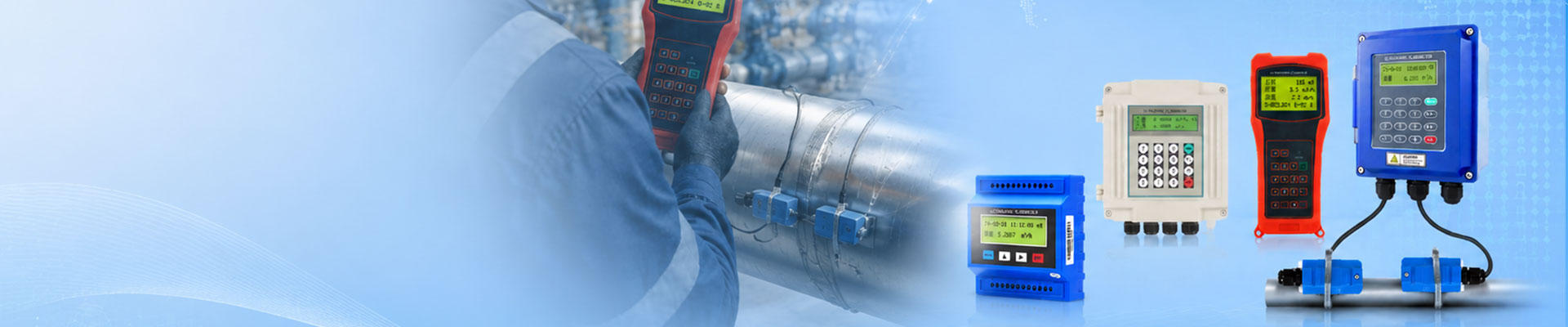
Two transducers clamp onto the pipe exterior. One sends an ultrasonic pulse through the pipe wall and the flowing liquid. The second transducer receives the signal. The meter calculates the time difference between upstream and downstream travel. That delta converts directly to flow velocity. Multiply velocity by the cross-sectional area of the pipe, and you get volumetric flow rate in m³/h, L/min, or GPM. No moving parts, no pressure drop, no risk of leakage.
Where Non-Invasive Flow Monitoring Saves Operations
We see clamp-on acoustic monitors deployed in places where downtime is simply not allowed. A desalination plant in Saudi Arabia uses our dual-channel unit on DN200 GRP pipes to track seawater intake and brine reject. In Australia, wastewater utilities strap meters onto old cement-lined ductile iron pipes without shutting down the network. Food and beverage teams in Thailand measure CIP return flows and pasteurized milk lines without breaking sanitary boundaries. A chemical blending plant in Mexico uses an ATEX Zone 1 rated clamp-on flow meter on a toluene transfer line operating at 18 bar. Every case shares one requirement: measure flow from outside the pipe.
Specifications That Make a Difference on Site
Pipe material matters. Our acoustic meters work on carbon steel, SS304, SS316, PVC, PE, and copper. Pipe wall thickness can reach 50 mm on some models. Fluids must be sonically conductive and free of large gas pockets or slurries with high solids loading, though some aeration is acceptable. Accuracy reaches ±1% of reading with proper straight-run installation. Temperature range spans -20 °C to 150 °C as standard; a high-temperature version extends to 200 °C. Outputs include 4-20 mA HART, MODBUS RTU, and pulse. For energy monitoring, the transducer block accepts a PT100 input so the meter computes mass flow and heat flow simultaneously. Display shows totalizer, flow rate, and diagnostic signal strength.
Engineers often ask about minimum conductivity. Here is the thing: this meter uses ultrasound, so conductivity is irrelevant. It works on demineralized water, raw water, oils, solvents, and various chemicals with viscosity up to 300 cP. We have qualified it on palm oil, caustic soda, light fuel oil, and glycol. Pipe diameters we support range from tiny DN15 copper tubes in pilot plants up to DN3000 concrete mains.
Why Choose Silver Instruments Over Generic Suppliers
Most clamp-on flow meter suppliers ship a box and disappear. We configure each unit before dispatch so your team unwraps a meter that already has the correct pipe parameters and output scaling dialled in. We stock transducers for small, medium, and large pipes in our Nanjing warehouse and ship within three working days via DHL, FedEx, or sea freight. Customers in Kenya, Vietnam, Peru, and the UAE have received replacement meters inside a week. Technical support runs on WhatsApp and
Price advantage is real. Because we design and calibrate in-house, we ship a factory-direct clamp-on flow meter for 30 to 50 percent less than what local distributors quote in Sydney or Singapore. That gap often turns a budget rejection into an approved purchase.
A Real Installation Story from a Dairy Powder Plant
Last year a dairy powder manufacturer in New Zealand contacted us with a challenge. They were hand-weighing whey concentrate batches because their old magnetic flow meter had failed, and a line stop for replacement would cost over AUD 12,000 a day in lost production. We shipped a compact clamp-on acoustic meter with IP67 transducers matched to their existing DN50 SS316 pipe. Their maintenance electrician mounted the sensors with stainless straps in 40 minutes. No welder, no hot work permit. The meter fed 4-20 mA to the plant DCS, and within the same shift the client had live flow data with a repeatability better than 0.5 percent. The meter paid for itself before the first CIP cycle ended.
What to Prepare When You Ask for a Quote
We can propose a model within one hour if you share these six data points. Pipe outside diameter or DN. Pipe material and exact wall thickness if known. Fluid name, operating temperature in °C, and maximum pressure in bar. Required output signals: 4-20 mA HART, RS485, pulse, or relay. Hazardous area classification, for example ATEX Zone 2 or safe area. Target flow range, for instance 0.5 to 15 m³/h or 100 to 3000 L/h.
Send these details to [email protected]. You can also reach our application team on Tel: +86-25-68650347, WhatsApp: +86-25-52155837, or WeChat: +86 15365082610. We often provide a same-day quotation with a technical datasheet and a dimensional drawing of the transducer mounting frame.
Frequently Asked Questions
Can a clamp-on meter handle wastewater with suspended solids? It works on screened wastewater or effluent with less than 3 percent solids by volume. High sludge content attenuates the acoustic signal and causes dropouts. For raw sewage, we recommend a full-bore electromagnetic flow meter instead.
Do we need to drain the pipe or stop flow for installation? No. The transducers clamp onto the outside while the line remains live. This is the main reason process engineers choose non-invasive acoustic monitors for retrofits.
Is pipe material a limitation? Solid metal and rigid plastic pipes transmit ultrasound well. Lined pipes, old concrete with air pockets, and heavily corroded or delaminated walls create signal scattering. We can test a pipe section if you provide a sample or ultrasonic thickness gauge readings.
How accurate is a clamp-on flow meter compared to an inline Coriolis mass flow meter? Under good conditions, accuracy reaches ±1 percent of reading. A Coriolis meter can do ±0.1 percent, but it requires inline installation and comes at a much higher cost plus pressure drop. For inventory tracking, dosing, and process control, ±1 percent is sufficient in most plants we serve.
What is the typical delivery time to Africa or the Pacific Islands? If we have your pipe size in stock, we dispatch within 3 business days. DHL delivery to Lagos, Nairobi, Jakarta, or Port Moresby takes 5 to 8 days on average. Sea freight to the Middle East or Latin America adds 3 to 4 weeks for large orders. We supply pro-forma invoices with HS code 90261000 for smooth customs clearance.