

 Current position > Product detail
『How Does a Water Flow Meter Work: Captures fluid kinetic movements or signal phase shifts to determine totalized water distribution volume.』Related information(v cone flow meter|rotary gas meter|gallon meter|gear meter|metal tube rotameter|glass tube rotameter|nutating disk meter|transit time ultrasonic flow meter|wedge flow meter|pd meters|hydraulic flow meter|ultrasonic water flow meter|water flow meter|air flow meter|magnetic water flow meter|oxygen flow meter|gas flow meter|argon flow meter|air velocity meter|gasoline flow meter|fuel flow meter|ultrasonic water meter|digital water meter|nitrogen flow meter|solid flow meter|Oxygen tank flow meter|digital water flow meter|diesel fuel flow meter|steam flow meter|02 flow meter|compressed air flow meter|oil flow meter|liquid flow meter)
How Does a Water Flow Meter Work for Water Distribution Totalization
Quick Answer: A water flow meter captures fluid kinetic movements or signal phase shifts and converts that signal into a flow rate. The transmitter totalizes the flow rate over time to give totalized water distribution volume. Silver Automation Instruments supplies electromagnetic, ultrasonic, vortex, and Coriolis water flow meters for DN15 to DN300 lines.
Water distribution systems in Southeast Asia, the Middle East, Africa, and Latin America depend on accurate totalized volume. The totalizer value is used for billing, leak detection, batching, and government reporting. The working principle changes by meter type. You need to know which principle fits your water quality and pipe size.
Mechanical Water Flow Meters Use Fluid Kinetic Movements
Mechanical meters such as turbine, paddle wheel, and impeller types place a moving part in the flow. Water pushes the part. The kinetic energy of the fluid creates rotation. A magnetic pickup or reed switch detects each rotation and sends a pulse to the transmitter or PLC.
Here is the thing. The pulse output is not a raw signal. Each pulse represents a fixed volume. For example, a DN50 turbine water flow meter from Silver Instruments can be calibrated to a K factor of 320 pulses per liter for clean water at 20 °C. The totalizer counts those pulses over time. That count is your totalized water distribution volume.
Mechanical meters are simple and low cost. But they do not like suspended solids or sticky liquids. In practice, many water utility customers in Vietnam and Indonesia start with a mechanical meter and later switch to an electromagnetic meter when the impeller jams.
Electromagnetic Flow Meters Read Induced Voltage
An electromagnetic water flow meter has no moving part. It works on Faraday law. Conductive water moves through a magnetic field. Two electrodes measure a small induced voltage that increases with flow velocity.
This type is the standard choice for raw water, treated water, and wastewater. The fluid needs a minimum conductivity of 5 µS/cm. For a DN100 distribution line, an electromagnetic meter with 4-20 mA HART output, PT100 temperature input, and pulse totalization fits most SCADA systems.
We have seen this on customer sites many times. A water treatment plant in Saudi Arabia needed a DN150 electromagnetic flow meter for a distribution header. They asked for a local totalizer display, IP67 housing, and Modbus RTU. That meter replaced a mechanical totalizer and reduced maintenance. Accuracy of ±0.5% of reading is common for this type.
Ultrasonic Flow Meters Work on Signal Phase Shift
Ultrasonic transit time meters send sound pulses upstream and downstream. Moving water changes the travel time of each pulse. Some ultrasonic designs measure a signal phase shift directly. The transmitter turns that difference into flow velocity and then into total volume.
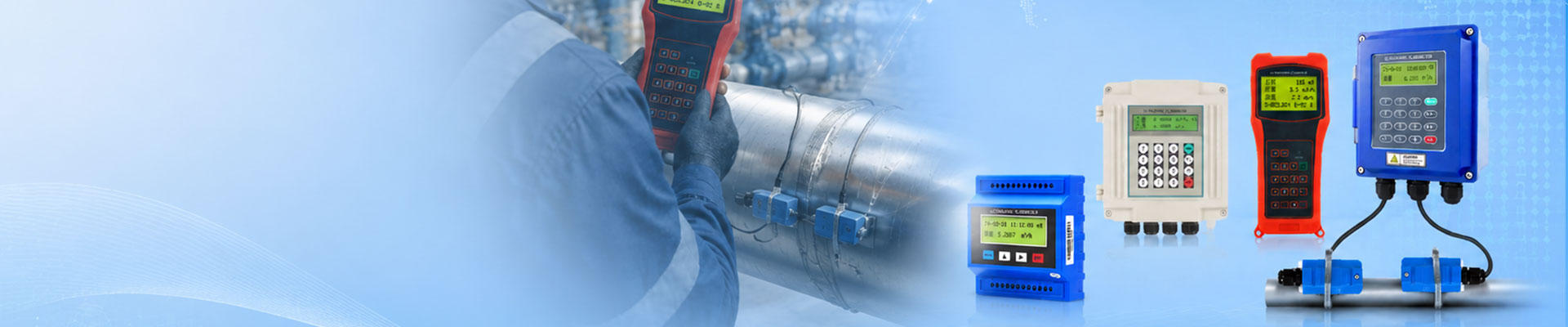
Because there is no contact with the fluid, clamp on ultrasonic meters are a good fit for large steel or concrete pipes. They are used in desalination plants, irrigation networks, and building water distribution. A Silver Instruments clamp on ultrasonic meter handles pipe sizes from DN50 to DN3000. Accuracy is around ±1.0% of reading when the flow profile is stable.
Doppler ultrasonic meters work better with bubbles or particles in the water. Transit time meters work better in clean water. Tell us your pipe material and water condition befo
_600x400.jpg)
Coriolis And Vortex Meters for Specific Water Applications
Coriolis mass flow meters measure mass directly. They detect phase shift between vibrating tubes. They are not the cheapest choice for plain water distribution. But they are useful in food and beverage plants that dose water, syrup, or cleaning chemicals. Silver Instruments Coriolis meters measure kg/h, density in kg/m3, and temperature in °C. Some models are approved for ATEX Zone 1 when flammable liquids are present.
Vortex meters use fluid kinetic movement to create alternating vortices behind a bluff body. The frequency of the vortices gives flow velocity. They are more common in steam and compressed air, but they can also measure clean water at high temperature and high pressure.
Output Signals for Totalized Water Distribution Volume
The sensor alone does not finish the job. You need a transmitter that totalizes flow and sends the data to a PLC, SCADA, or local display. Most Silver Instruments water flow meters include 4-20 mA HART, pulse output, and Modbus RTU. Use the pulse output for external electromechanical counters or high speed PLC inputs.
For billing, the totalizer needs to be protected. Ask for a password lock on the totalizer and a non resettable counter if tampering is a risk. Some water utilities in Nigeria and Kenya request this feature for district metering zones.
How to Size a Water Flow Meter for Distribution
Step one is pipe size. Read the actual internal diameter, not just the nominal DN. Wall thickness changes the inside diameter.
Step two is flow range. Know the minimum and maximum flow in m3/h. A meter with a turndown of 20:1 or 40:1 gives better low flow reading than a mechanical meter with a narrow band.
Step three is water condition. For wastewater with solids, choose an electromagnetic meter with a PTFE liner and tungsten carbide electrode. For desalination plant seawater, ask for titanium electrodes and a corrosion resistant liner.
Send us your pressure in bar, temperature in °C, pipe size in DN, and flow range. We will reply with a specific meter model and price. Tel: +86-25-68650347. WhatsApp: +86-25-52155837. WeChat: +86 15365082610.
FAQ: Water Flow Meter Working Principle and Selection
Q: What does a water flow meter actually measure?
A: It measures flow velocity or mass flow and then calculates volume per time. The electronic totalizer adds that volume over hours, days, or months to give totalized water distribution volume.
Q: Do electromagnetic water flow meters work with all water types?
A: They work with most conductive water. Conductivity should be above 5 µS/cm. Pure distilled water or some glycol mixes need a different meter type.
Q: Which meter is best for a seawater intake in a desalination plant?
A: A clamp on ultrasonic meter or an electromagnetic flow meter. For seawater, ask for titanium electrodes and a corrosion resistant liner from Silver Instruments.
Q: Can one meter give both flow rate and totalized volume?
A: Yes. Most Silver Instruments transmitters show live flow rate and totalized volume on the same local display. They also send totalization data over 4-20 mA HART or Modbus.
Q: How do I get a price for a DN100 water distribution meter?
A: Send us your pressure in bar, temperature in °C, pipe size in DN, and flow range. Tel: +86-25-68650347. WhatsApp: +86-25-52155837. WeChat: +86 15365082610.