

 Current position > Product detail
『Fuel Oil Coriolis Flow Meter Marine Selection Guide』Related information(v cone flow meter|rotary gas meter|gallon meter|gear meter|metal tube rotameter|glass tube rotameter|nutating disk meter|transit time ultrasonic flow meter|wedge flow meter|pd meters|hydraulic flow meter|ultrasonic water flow meter|water flow meter|air flow meter|magnetic water flow meter|oxygen flow meter|gas flow meter|argon flow meter|air velocity meter|gasoline flow meter|fuel flow meter|ultrasonic water meter|digital water meter|nitrogen flow meter|solid flow meter|Oxygen tank flow meter|digital water flow meter|diesel fuel flow meter|steam flow meter|02 flow meter|compressed air flow meter|oil flow meter|liquid flow meter)
Fuel Oil Coriolis Flow Meter Marine Selection Guide
Quick Answer: For fuel oil measurement on ships, you need a Coriolis meter with Ex approval, a secondary containment, and a low-frequency driver for heavy oil. Stainless steel 316L wetted parts handle high viscosity and sulfur content. The meter must ignore vessel pitch and roll.
Marine fuel oil measurement is not the same as land-based bunkering. You face constant motion, high viscosities up to 500 cP at low temperature, and a crew that trusts hardware more than software. Silver Automation Instruments has supplied Coriolis meters for bunker barges, deep-sea cargo vessels, and offshore support ships across Southeast Asia, West Africa, and the Middle East. Here is what we learned.
Why a Coriolis meter and not another technology
Positive displacement meters wear when you run heavy fuel oil with abrasive particles. Turbine meters choke on high viscosity. Differential pressure flow meters require straight pipe runs that engine rooms rarely have. Coriolis meters give you mass flow directly, no compensation for density changes needed. One less thing to calibrate when you are 12 nautical miles offshore.
Most engineers skip this part, but on a ship, air entrainment is common because fuel tanks slosh. A Coriolis meter with entrained gas management still gives usable flow and density readings where an ultrasonic meter would lose signal completely. We have seen this on customer sites many times: a tanker off Angola switching between cheap IFO 380 and marine diesel, the flow meter has to handle viscosity swings from 2 cP to 700 cP in one bunkering operation.
Materials that survive fuel oil
Hastelloy is overkill for fuel oil unless you are blending acids. Stainless steel 316L is the standard and works for IFO 180, IFO 380, VLSFO, and MGO. The wetted parts you need to check are the measuring tubes, manifolds, and any process connections. Silver Instruments builds our Coriolis meters with full 316L wetted parts as default.
Fuel oil in the Middle East often has high sulfur content, and when it cools, you get sulfuric acid condensation in vent lines. This attacks poor sealing materials. We specify FKM or FFKM O-rings for the sensor housing. PTFE is too soft and cold-flows under cyclic pressure. A customer in Vietnam learned that the hard way after his bunker meter leaked at the flange gasket within six months. He replaced it with a meter using graphite-stainless spiral wound gaskets and the problem disappeared.
Ex approvals are not optional
Engine rooms and pump rooms on oil tankers fall under Zone 1 or Zone 2. You need ATEX, IECEx, or local equivalent certification for the meter transmitter and the sensor. Silver Automation Instruments offers Coriolis meters with Ex ia IIC T4 hazardous area approval. The sensor is intrinsically safe when wired to an isolated barrier in the control cabinet.
Because many yards in Asia now build to class society rules, we also supply meters with DNV and Bureau Veritas type approval certificates. A shipyard in Batam asked us exactly for this last year. They needed a 2-inch Coriolis with BV certificate for a fuel oil transfer skid. We shipped the meter with stainless tags stating the certificate number and the serial. The surveyor signed off in one visit.
Sizing for fuel oil: DN, flow range, and density
Here is the thing: sizing a Coriolis meter for marine fuel oil is mostly about minimum flow, not maximum. When a ship is at anchor, the generator engines run at low load and the fuel consumption drops to 100 to 300 kg/h. A meter that is too large will not register flow at that rate.
We recommend DN15 or DN25 for small auxiliary engines up to 1,000 kg/h. For main engine fuel supply lines, DN40 or DN50 covers 2,000 to 15,000 kg/h easily. For bunker receiving lines, DN80 or DN100 handles 30,000 to
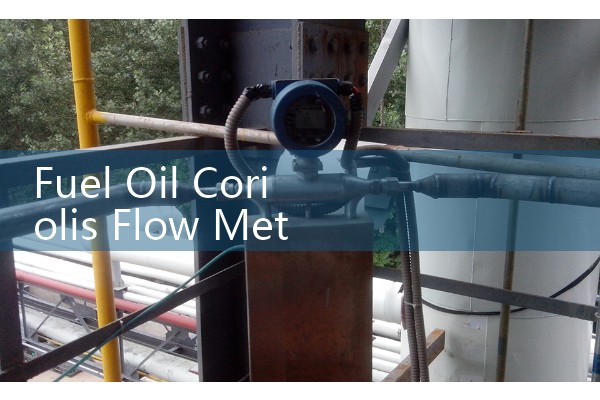
Density calibration matters. The meter converts tube vibration into density. Heavy fuel oil at 15°C can have density from 950 to 1,010 kg/m3. We calibrate each meter on a traceable water and oil rig at 20°C, then apply the temperature correction factor for your working temperature. If you operate at 120°C to 140°C for IFO, the density offset without proper temperature compensation will be large enough to affect bunker custody transfer calculations.
Installation that works on a vibrating ship
In practice, you mount the Coriolis sensor with the flow from bottom to top to keep the tubes full. Follow the zero point check procedure after installation while the ship is at quay without engine running. Do not place the meter close to a reciprocating fuel pump. That pulsation fools the mass flow calculation. Put a pulsation damper upstream or move the meter further down the line.
We have seen installers use rigid pipe supports that transmit hull vibration straight into the sensor. That costs you accuracy. Use a flexible hose connection on both sides or mount the sensor on a standalone bracket with rubber pads. The meter itself does not need straight pipe runs, so you can fit it into tight spaces below the deck.
Outputs for ship automation
Engine room monitoring systems expect 4-20 mA HART, pulse, or Modbus RTU RS485. Silver Instruments transmitters output mass flow, density, and temperature on separate analog channels. This integrates with Kongsberg, Nabtesco, and custom PLC panels we see in Asian-built ships.
For bunker custody transfer, we enable the batch control function inside the transmitter. The operator enters the target mass in kilograms on the local display, hits start, and the meter stops the valve when the batch is complete. This avoids overspill claims. The transmitter stores the last 50 batches with timestamp and total.
Send us your fuel type, operating pressure (bar), temperature (°C), pipe size (DN), and minimum to maximum flow range. We will return a quote with the exact model code, Ex certificate datasheet, and lead time to your nearest port. Silver Automation Instruments ships from Singapore warehouse for fast delivery across Southeast Asia, Oceania, and the Middle East.
Frequently Asked Questions
Can I use the same Coriolis meter for IFO and MGO?
Yes, if you specify the meter for the full viscosity and density range. Write down both the light fuel and the heavy fuel parameters when you request a quote. The sensor does not care about viscosity, but the flow turndown changes. A meter sized for IFO may have poor low-flow cut-off for MGO.
What happens if the meter tube is partially empty during ship rolling?
The meter detects mixed-phase flow and will raise an alarm. For heavy rolling, select a meter with horizontal tube orientation and keep flow upward. The entrained gas algorithm holds the last valid flow value for a configurable time.
Do you supply with class society certificates?
Yes, we work with DNV, BV, and RINA. Mention the class society when you send your inquiry. We submit the meter documentation to the society and deliver the certificate with the hardware.
How do I prevent measurement error from fuel temperature changes?
The built-in PT1000 temperature sensor compensates mass flow to a reference temperature automatically. You can set the reference to 15°C for standard marine reporting. The density output is live and already temperature-corrected.
What is the lead time for a marine-approved Coriolis meter?
Standard meters with 316L and Ex ia approval ship from Singapore in 2 to 3 weeks. Meters requiring specific class society certification may need 4 to 6 weeks because of document review.