

 Current position > News detail
『Oil Flow Meter for Hot Oil System: Loop Balance and Vapor Air Pocket Prevention』Related information(v cone flow meter|rotary gas meter|gallon meter|gear meter|metal tube rotameter|glass tube rotameter|nutating disk meter|transit time ultrasonic flow meter|wedge flow meter|pd meters|hydraulic flow meter|ultrasonic water flow meter|water flow meter|air flow meter|magnetic water flow meter|oxygen flow meter|gas flow meter|argon flow meter|air velocity meter|gasoline flow meter|fuel flow meter|ultrasonic water meter|digital water meter|nitrogen flow meter|solid flow meter|Oxygen tank flow meter|digital water flow meter|diesel fuel flow meter|steam flow meter|02 flow meter|compressed air flow meter|oil flow meter|liquid flow meter)
Oil Flow Meter for Hot Oil Systems: Loop Balance and Vapor Pocket Prevention
Quick Answer: A positive displacement oval gear flow meter or a Coriolis mass flow meter with high-temperature rating (up to 350°C) can deliver stable hot oil measurement if you eliminate vapor pockets first. Always install the meter at the lowest point of the pipe loop, maintain at least 0.5 bar backpressure, and commission the system with a slow thermal soak to drive out trapped air. Silver Instruments supplies DN15–DN100 oval gear meters with PT100 temperature compensation and 4-20 mA HART output for thermal oil circuits.
Why Most Hot Oil Flow Meters Fail at Start-up
In practice, an engineer will wire a new flow meter, fire the burner, and then watch the display jump from zero to overload in a few minutes. The oil itself is not the problem. The culprit is almost always a vapor bubble that forms during ramp-up, settles in the meter chamber, and causes the rotor to spin empty. Once the bubble passes, hot oil at 280°C slams back in and the torque spike fractures a gear or bends the rotor shaft. We have seen this on customer sites in Malaysia, Nigeria, and Thailand across thermal oil systems running at 15–20 bar pressure. The fix is never just a stronger meter. It is a loop balance strategy that keeps the liquid single-phase from cold start to full load.
Loop Balance: Keep the Meter Full, Always
A balanced loop means the pressure at the meter inlet never drops below the vapor pressure of the hot oil. For a typical mineral-based thermal oil at 300°C, the vapor pressure can be as low as 0.2 bar absolute. If your circulation pump creates a suction zone or your piping has a high point vent that is shut, you can dip below that number for a few seconds. That is all it takes to flash vapor. The cure is to reposition the meter after the main circulating pump discharge and before the process heat exchangers. In a DN50 line carrying 6,000 kg/h of Therminol 66, a backpressure control valve set at 1.2 bar holds the entire measuring section liquid-tight. Silver Instruments often pre-configures oval gear meters with a downstream spring-loaded check valve to maintain this minimum backpressure without an extra control loop.
Vapor Pocket Prevention: The Thermal Soak Method
Most engineers skip this part. They put a new meter inline, open the isolation valves, and start the pump. A smarter way is the thermal soak. First, crack open the bypass line and let cold oil circulate for 30 minutes at 20% pump speed. This forces small bubbles to the expansion tank. Next, raise the oil temperature at a rate of 2–3°C per minute while watching the meter’s electronics for any sudden signal loss. Use a clamp-on PT100 sensor wired to a paperless recorder to track the pipe skin temperature vs the internal fluid temperature. If the difference exceeds 10°C, pause the ramp and hold until the gap closes. A food-grade hot oil system in a Singapore fryer plant we supported cut their meter failure rate from three units per year to zero just by adopting this soak profile. Their DN25 oval gear meter now runs 24/7 at 240°C with less than 0.5% drift.
Flow Meter Selection for Hot Oil Service
You cannot simply pick a meter rated for 200°C and hope it survives a 300°C smoke-point oil. Here is what we specify when a customer in the Middle East or Latin America asks for a hot oil flow meter quote:
Positive displacement oval gear meters: These offer repeatability of ±0.2% of reading and do not require straight pipe runs. Silver Instruments uses hardened steel rotors and PEEK or PTFE seals rated up to 350°C. For thermal oils with high kinematic viscosity (above 50 cSt at 40°C), oval gear meters deliver better low-flow accuracy than turbine meters. A DN15 meter handles 0.5–50 L/min and reports via a 4-20 mA HART loop direct to a PLC or SCADA.
Coriolis mass flow meters: When you need density measurement alongside mass flow to monitor thermal oil degradation, a D-series Coriolis sensor from Silver Instruments can run up to 350°C with a Hastelloy tube option. It gives kg/h, density in kg/m³, and temperature in one device. Because the meter tube is fully welded and has no moving parts, vapor bubbles cause a momentary density alarm rather than a mechanical failure. This makes it ideal for start-stop reactor heating loops where air ingress is frequent.
Vortex and ultrasonic meters: Vortex sheds in thin hot oil can produce a noisy signal below 2 m/s. Doppler ultrasonic clamp-on meters struggle with the laminar flow profile of high-
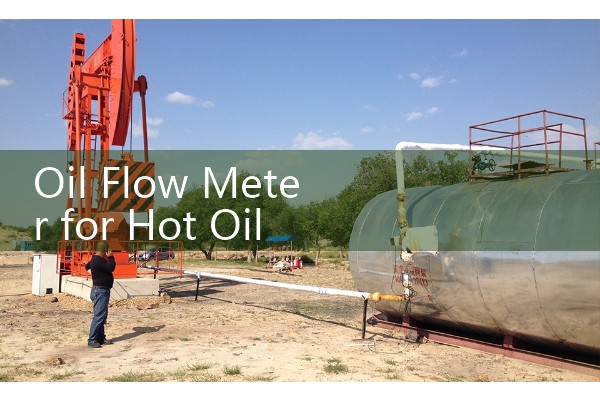
Installation Details That Prevent Air Pockets
In a hot oil skid, the piping layout decides the meter’s lifespan. Follow these rules:
• Locate the meter at the lowest elevation of the loop, never at a high point where gas collects.
• Install a Y-strainer 15 pipe diameters upstream with a magnetic insert to catch metallic debris from pump wear.
• Use dead-volume-free flanges (weld-neck) and avoid threaded connections on lines above 25 bar and 300°C.
• Fit a sight glass after the meter to visually check for bubble carry-over during commissioning.
• Slope the pipe upward toward the expansion tank so any gas released during thermal soak migrates away from the meter.
A textile plant in Turkey running a 4 MW hot oil heater on a DN65 main loop shared a common mistake: they installed the meter just before the burner return line at a high elbow. Air pockets formed every night shutdown. After moving the meter downstream of the circulating pump at a low-point drain nozzle, the morning error spikes stopped entirely. They now run a Silver Instruments oval gear meter with a local LED totalizer and 4-20 mA output to their energy management system.
Real-World Trouble: Southeast Asia Paint Reactor
A paint manufacturer in Vietnam operates a jacketed reactor with a hot oil secondary loop at 280°C and 5 bar. Their original flow meter (a turbine type) would overspeed when a vapor slug hit the blades. The result was a batch temperature deviation of more than 5°C and scrapped product worth USD 8,000. Silver Instruments replaced it with a DN40 Coriolis meter with ATEX Zone 1 certification and a built-in density alarm. During a controlled start-up, the density reading dropped from 870 kg/m³ to 12 kg/m³ for two seconds, the meter flagged a gas warning, and the control system held the burner ramp until the density recovered. No damage, no scrap. The customer now runs the same meter for 18 months without calibration drift.
FAQ: Hot Oil Flow Meter Selection and Air Pocket Issues
Q1: Can I use a magnetic flow meter for hot oil?
No. Mag meters require a conductive liquid (minimum 5 µS/cm). Thermal oils are non-conductive. Use oval gear, Coriolis, or vortex meters instead.
Q2: What signal output works best for hot oil flow measurement?
4-20 mA HART is the industry standard because it transmits flow rate and temperature over a single pair of wires. Silver Instruments also offers Modbus RTU and pulse outputs for burner control panels.
Q3: How often should I recalibrate a hot oil oval gear meter?
If the oil is filtered to 100 mesh and the system never runs dry, every 18 months is enough. Plants that handle heavy fuel oil blends or experience frequent air slugs should calibrate annually with a reference master meter at the same operating temperature.
Q4: Does a Coriolis meter need straight pipe upstream?
Not normally. Coriolis meters are insensitive to flow profile. However, on a hot oil loop with vibration from a positive displacement pump, Silver Instruments recommends a flexible hose connection and a meter support bracket to isolate pipe stress.
Q5: Can I install a flow meter vertically in a hot oil line?
Yes, with flow upward. Vertical upward flow helps sweep any residual gas out of the meter body. Never install an oval gear meter with downward flow in a hot oil line because gravity can drain the measuring chamber and leave it dry after a shutdown.
Get a Fast Quote and Installation Drawing
Tell us your hot oil parameters and we will send a complete datasheet with meter size, wetted material, and backpressure calculation within 24 hours. We need these numbers: oil type (e.g. Therminol 55, Mobiltherm 605), operating temperature (°C), operating pressure (bar), flow range (kg/h or L/min), pipe size (DN), and whether you need ATEX Zone 1 or Zone 2 approval. Email your data to [email protected] or send a WhatsApp message to 86-135-12131526. You can also call our technical team at +86-135-1213-1526 or connect on WeChat: +86 13512131526. See our hot oil flow meter range with real customer case studies at flow-meter.com.au.