

 Current position >About Us
Air Flow Meters: Advanced Velocity Equipment for Industrial Pneumatics
Quick Answer
Velocity air flow meters measure the flow of compressed air, nitrogen, and other industrial gases in pipes from DN15 to DN300. Thermal mass flow meters and vortex flow meters are the most common choices for industrial pneumatics. They work without moving parts and give direct outputs in kg/h, Nm3/h, or m3/h. Send your gas type, pipe size in DN, pressure in bar, temperature in °C, and flow range to Silver Automation Instruments for a specific model and price.
What Counts as a Velocity Air Flow Meter
In industrial pneumatics, a velocity air flow meter reads the speed or mass velocity of gas passing through a pipe. The meter then converts that signal into a flow rate. Three main technologies cover most plant air and compressed gas applications. Thermal mass flow meters use heated sensors. Vortex flow meters count vortex shedding behind a bluff body. Differential pressure meters with averaging pitot tubes measure velocity pressure across the pipe cross section.
Each technology has a different strength. Thermal mass meters handle low flow and leak detection. Vortex meters handle high flow and saturated or dirty gas. Differential pressure meters tolerate high temperature and pressure when built with impulse lines and a transmitter. Most engineers choose based on pipe size, turndown, pressure drop, and whether they need mass flow or volumetric flow.
Thermal Mass Flow Meters for Compressed Air
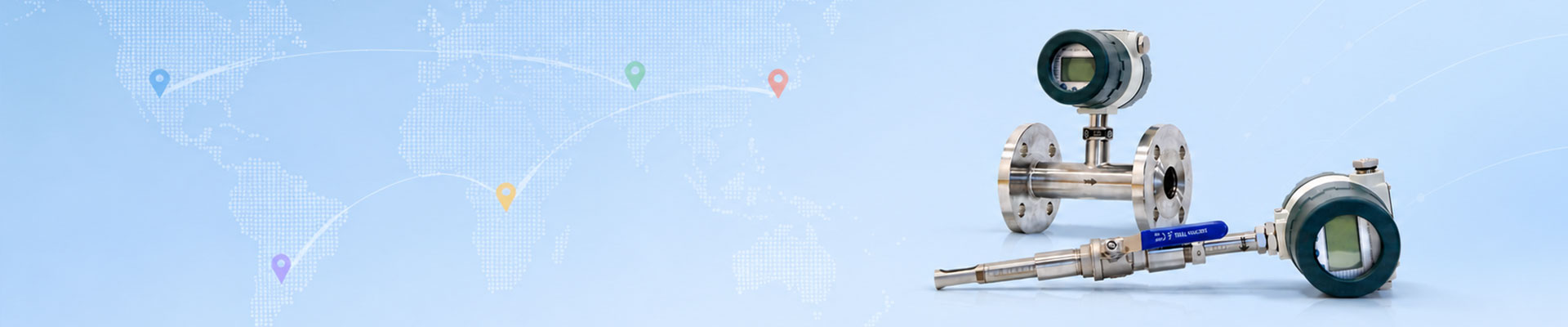
Insertion thermal mass flow meters are common on compressed air headers from DN80 to DN300. A probe inserts through a ball valve into the pipe. The sensor measures heat transfer from the gas flow. Thermal mass measurement gives mass flow directly without a separate pressure or temperature transmitter. Typical accuracy is plus or minus 1.5 percent of reading from about 0.5 to 100 metres per second.
We have supplied thermal mass air flow meters for a food packaging plant in Malaysia that needed to log total compressed air use across two production halls. The customer gave us a DN100 pipe, 8 bar pressure, and a flow range from 30 to 900 Nm3/h. We recommended an insertion probe with a 4-20 mA HART output and a local display. The meter found a 12 percent air leak during a shutdown test.
Vortex Flow Meters for High Flow Pneumatic Lines
Vortex flow meters fit many compressed air and nitrogen lines from DN25 to DN200. They measure volumetric flow by detecting the frequency of vortices. Vortex meters are less sensitive to moisture carryover than some thermal probes. A vortex meter with an integrated pressure and temperature sensor can output mass flow or standard volume flow. Typical turndown is 15 to 1 or 20 to 1 depending on the pipe size and Reynolds number.
For a compressed air system in the Philippines, a contractor needed a meter for a DN150 header at 10 bar. The flow range was 150 to 2200 Nm3/h. We supplied a vortex flow meter with integrated temperature and pressure compensation. The unit had pulse and 4-20 mA outputs for the plant energy management system. Installation required 15 pipe diameters upstream and 5 pipe diameters downstream to keep the velocity profile stable.
Differential Pressure and Averaging Pitot Options
Averaging pitot tubes work well for large duct and pipe sizes where inline meters are expensive. The sensor measures velocity pressure at several points across the pipe and sends a signal to a differential pressure transmitter. Averaging pitot systems suit dry compressed air, combustion air, and process gas lines. They also work at higher temperatures than many insertion thermal probes.
One limitation is low flow sensitivity. At velocities below about 5 metres per second, the differential signal becomes very small. Because of that, plants often use an averaging pitot for main headers above DN200 and reserve thermal