

『How a Magnetic Flow Meter Works: Principles and Industrial Applications』Related information(v cone flow meter|rotary gas meter|gallon meter|gear meter|metal tube rotameter|glass tube rotameter|nutating disk meter|transit time ultrasonic flow meter|wedge flow meter|pd meters|hydraulic flow meter|ultrasonic water flow meter|water flow meter|air flow meter|magnetic water flow meter|oxygen flow meter|gas flow meter|argon flow meter|air velocity meter|gasoline flow meter|fuel flow meter|ultrasonic water meter|digital water meter|nitrogen flow meter|solid flow meter|Oxygen tank flow meter|digital water flow meter|diesel fuel flow meter|steam flow meter|02 flow meter|compressed air flow meter|oil flow meter|liquid flow meter)

How a Magnetic Flow Meter Works: Principles and Industrial Applications
Quick Answer
A magnetic flow meter measures volumetric flow of conductive liquids. The meter creates a magnetic field across the pipe. When conductive liquid flows through this field, it generates a voltage. That voltage is directly proportional to flow velocity. Silver Instruments supplies magnetic flow meters from DN15 to DN2000 for water, wastewater, chemical, food, and marine applications.
Working Principle of a Magnetic Flow Meter
A magnetic flow meter, also called an electromagnetic flow meter, follows Faraday law of electromagnetic induction. Two coils on the outside of the flow tube generate a magnetic field. Electrodes inside the pipe wall pick up the voltage. The voltage appears only when a conductive liquid moves through the magnetic field. The flow rate is calculated from this voltage.
The meter does not measure mass flow. It measures volume flow. The output is typically m3/h, L/min, or GPM. If you need mass flow, you must add temperature or density compensation. For most water based liquids, volume flow is enough.
The signal is linear. That means a 4-20 mA HART output maps directly to the flow range. For example, 4 mA equals zero flow. 20 mA equals the maximum flow you set on the converter.
Key Components and Material Choices
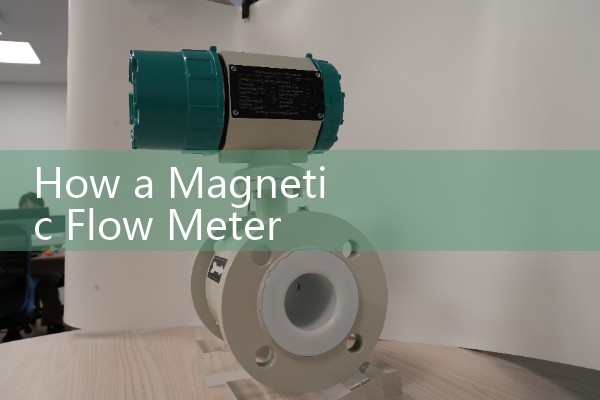
Silver Instruments magnetic flow meters have three main parts. The flow sensor body, the liner, and the electrodes. The liner protects the metal pipe from corrosion. The electrodes contact the liquid and collect the small voltage signal.
Liner materials include PTFE, PFA, hard rubber, soft rubber, and ceramic. PTFE works for acids and high temperature up to 180 °C. Hard rubber works for drinking water and wastewater up to 80 °C. Ceramic is best for abrasive slurries.
Electrode materials include 316L stainless steel, Hastelloy C, titanium, tantalum, and platinum. 316L is standard for water and most chemicals. Titanium handles seawater and brine. Hastelloy C resists strong acids. Tantalum works for hydrochloric acid.
Conductivity Requirements
Magnetic flow meters need a minimum liquid conductivity. Most Silver Instruments models require at least 5 µS/cm. Some low power models need 20 µS/cm. Tap water is usually 200 to 800 µS/cm. Seawater is about 50,000 µS/cm. Demineralized water, oil, gas, and most hydrocarbons do not have enough conductivity. Do not use a magnetic flow meter for those fluids.
In practice, many engineers ask about boiler feed water. After ion exchange, conductivity can drop below 5 µS/cm. That is too low for a standard mag meter. Check the conductivity before you select a meter.
Industrial Applications
Water and wastewater plants use magnetic flow meters for raw water intake, sludge transfer, chemical dosing, and effluent discharge. A common setup is a DN80 to DN300 mag meter with rubber liner and 316L electrodes. The output is 4-20 mA HART to a PLC or SCADA system.
Chemical plants use magnetic flow meters for acids, caustic, and solvents. PTFE liner and Hastelloy C electrodes are common. A paint manufacturer in Southeast Asia uses our DN25 magnetic flow meter to dose solvent at 2 m3/h. The meter has a PTFE liner and a 4-20 mA HART output.
Food and beverage plants use sanitary magnetic flow meters. These meters have stainless steel bodies and PFA liners. They meet CIP and SIP cleaning cycles. A dairy in New Zealand uses our DN50 sanitary mag meter to measure milk flow at 15,000 L/h.
Marine and offshore applications use magnetic flow meters for seawater cooling, ballast water treatment, and bilge water. Titanium electrodes and hard rubber liner work well in seawater. Silver Instruments can supply meters w
Desalination plants use magnetic flow meters for brine, seawater feed, and permeate. A customer in Vietnam ordered 12 magnetic flow meters for a desalination plant. Pipe sizes were DN100 and DN150. Flow ranges were 80 m3/h to 300 m3/h. The liners were rubber and the electrodes were titanium.
How to Select a Magnetic Flow Meter
Start with the pipe size and flow range. Magnetic flow meters work best at flow velocities between 0.5 m/s and 10 m/s. For a DN100 pipe, a typical flow range is 15 m3/h to 150 m3/h. For DN200 pipe, 60 m3/h to 600 m3/h.
Then check the fluid temperature and pressure. Standard meters handle up to 120 °C and 16 bar. High pressure versions go up to 40 bar. High temperature versions go up to 180 °C with PTFE liner.
Choose the liner and electrode based on the fluid. Then choose the output and approvals. Silver Instruments offers 4-20 mA HART, pulse, Modbus RS485, and Profibus DP. ATEX Zone 1 and IECEx versions are available for hazardous areas.
Silver Instruments model SIL-MF-100 covers DN15 to DN300 with rubber liner. Model SIL-MF-200 covers DN25 to DN200 with PTFE liner. Model SIL-MF-300 is for sanitary food and beverage use.
We have seen this on customer sites many times. The meter was selected for the right flow range but the liner was wrong. A water plant in the Philippines used soft rubber liner for water with chlorine. The rubber swelled after three months. We replaced it with EPDM rubber. Always tell your supplier the full fluid composition.
Installation and Grounding
Install the magnetic flow meter with at least 5D straight pipe upstream and 3D downstream. D means the pipe diameter. This rule reduces flow profile distortion. For a DN100 meter, you need 500 mm straight pipe before the meter.
Grounding is critical. The voltage signal is very small. Electrical noise can destroy the reading. Use grounding rings or grounding electrodes. Connect the ground wire to a good earth point. In plastic pipes, always use grounding rings.
Empty pipe detection is a useful feature. The meter can detect an empty pipe and stop the output. This prevents false readings when the pump is off.
FAQ
What is the minimum conductivity required for a magnetic flow meter?
Most Silver Instruments magnetic flow meters need at least 5 µS/cm. Some models need 20 µS/cm. Check the exact model. Do not use a magnetic flow meter for distilled water, oil, or gas.
Can a magnetic flow meter measure gas or steam?
No. Magnetic flow meters measure conductive liquids only. Gas, steam, and air do not generate a measurable voltage.
What is the typical turndown ratio?
Many mag meters have a turndown ratio of 150:1. Some reach 1000:1. The 4-20 mA HART output supports this range without losing accuracy.
Do magnetic flow meters need straight pipe run?
Yes. Use at least 5D upstream and 3D downstream. This reduces flow profile errors and improves accuracy.
What liner and electrode materials should I choose?
For drinking water, use rubber liner and 316L electrodes. For acids, use PTFE liner and Hastelloy C. For seawater, use rubber liner and titanium electrodes. For abrasive slurries, use ceramic liner and 316L or tungsten carbide electrodes.
Get a Quote from Silver Instruments
Send us your fluid name, pipe size (DN), flow range, pressure (bar), temperature (°C), and output signal. We will recommend a specific model and send a quote within 24 hours. Contact Silver Automation Instruments at Tel: +86-25-68650347, WhatsApp: +86-25-52155837, WeChat: +86 15365082610. You can also visit flow-meter.com.au for technical data sheets.
 Hot Product
 Related AD