

『Homemade Air Flow Meter DIY Projects: Building Simple U-Tube Manometer Venturi Testing Rigs』Related information(v cone flow meter|rotary gas meter|gallon meter|gear meter|metal tube rotameter|glass tube rotameter|nutating disk meter|transit time ultrasonic flow meter|wedge flow meter|pd meters|hydraulic flow meter|ultrasonic water flow meter|water flow meter|air flow meter|magnetic water flow meter|oxygen flow meter|gas flow meter|argon flow meter|air velocity meter|gasoline flow meter|fuel flow meter|ultrasonic water meter|digital water meter|nitrogen flow meter|solid flow meter|Oxygen tank flow meter|digital water flow meter|diesel fuel flow meter|steam flow meter|02 flow meter|compressed air flow meter|oil flow meter|liquid flow meter)

Homemade Air Flow Meter DIY Projects: Building Simple U-Tube Manometer Venturi Testing Rigs
Quick Answer: A homemade U-tube manometer and Venturi test rig can measure low pressure air flow in a workshop or R and D bench. This setup works for filter pressure drop, blower performance checks, and rough prototype work. For calibrated flow data, specify an industrial air flow meter from Silver Automation Instruments.
Most engineers start this project because they need a quick check of air flow without spending a large amount on a lab grade instrument. The U-tube manometer is simple. It has a clear plastic tube, water or light oil, and a ruler. The Venturi section creates a repeatable pressure drop. That pressure drop gives you a rough flow rate.
What You Can Measure with a DIY U-Tube Manometer Venturi Rig
You can measure differential pressure in Pascal or millibar. You can estimate air velocity in meters per second. You can calculate volumetric flow in cubic meters per hour when you know the pipe area. This is useful for small blowers, ducts, cleanroom filter test boxes, and school labs. The readings are not traceable to a national calibration standard. Do not use them for custody transfer or safety systems.
Materials and Setup for a Basic Air Flow Test Bench
You need a length of clear PVC tube with an inner diameter around 6 mm to 10 mm. You need water, food dye, a ruler, and two static pressure taps. A shop built Venturi can use a PVC pipe reducer. A DN50 to DN25 reducer is a good starting point for small air flows. For an air flow range of 10 kg/h to 100 kg/h, a DN25 throat works well. For larger flows up to 500 kg/h, use a DN50 throat and a DN80 upstream pipe.
In practice, most DIY builders skip the true Venturi geometry and use an orifice plate. An orifice plate is easier to cut from a flat plastic sheet. The pressure taps go upstream and downstream. One tap sits about one pipe diameter before the plate. The other tap sits a half diameter after the plate. This layout gives a strong differential pressure signal.
Step by Step Build Notes
First mount the test section on a level surface. Angle the U-tube manometer vertically. Add water until both columns sit at the zero mark. Connect the high side to the upstream tap and the low side to the downstream tap. Secure the plastic tube fittings with small thread sealant or compression fittings. A leak in the impulse line will make the reading bounce. Most engineers skip this part in a rush. Tightening the fittings first saves you hours later.
Run the blower or compressed air line. Start at the lowest flow setting. Record the manometer height difference in millimeters. Repeat at ten points across the range. This gives you a rough curve of differential pressure against flow. Plot the points in a spreadsheet or a paper logbook. Keep the ambient temperature steady. Air density shifts with temperature. A 5 °C shift can change the calculated flow by about 1 percent.
How to Calculate Air Flow from Manometer Readings
The basic formula uses the square root of differential pressure. Flow rate equals K times the square root of delta P. K is your local discharge coefficient. For a shop built Venturi, K is not known exactly. You can estimate K from published tables but the uncertainty can reach 5 to 10 percent. For a thin plate orifice with a beta ratio of 0.5, you can use standard ISO 5167 equations to get a better starting point. The calculation needs pipe inside diameter, pressure, temperature, and gas density.
Let us say you read a pressure difference of 250 Pa across a DN50 Venturi at 20 °C. The estimated air flow might be around 40 kg/h to 60 kg/h depending on geometry. This is useful for a quick sanity check. It is not a replacement for a calibrated thermal mass flow meter or a vortex meter with dry air compensation.
Limits of Homemade Air Flow Meters
A U-tube manometer has slow response. It cannot track fast pulsating flow from a reciprocating compressor. The manometer fluid can evaporate or freeze. Water is not a good choice below 4 °C. Use light oil if the test area gets cold. The Venturi and the impulse lines can clog if the air contains dust, paint overspray, or water mist. Accuracy is rough. Process engineers should not use this DIY rig for batch dosing, combustion control, or EPA monitoring.
Here is the thing. A DIY rig is a visual indicator, not a measurement instrument. We have seen this on customer sites many times. A plant builds a quick test rig to verify a blower, then leaves it in place for months. The readings dri
When to Switch to an Industrial Air Flow Meter
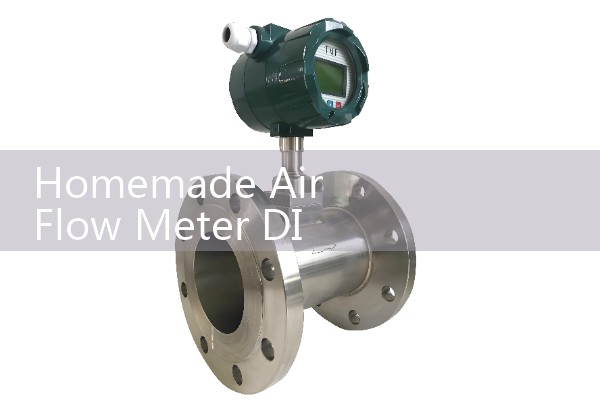
Switch when the data must be repeatable or when a customer asks for traceable flow readings. A thermal mass flow meter from Silver Automation Instruments gives direct mass flow in kg/h or standard cubic meters per hour. It handles air, nitrogen, biogas, and natural gas with inline or insertion mounting. For wet or dirty air, a vortex flow meter with temperature and pressure compensation works better. We also supply differential pressure transmitters with a 4-20 mA HART output if you want to keep a Venturi or orifice plate but improve the transmitter side.
Last year a paint manufacturer in Southeast Asia asked us about a homemade Venturi for spray booth air balance. The team wanted a cheap first test. We supplied a DN80 vortex flow meter with a 4-20 mA HART output and a PT100 temperature sensor. The total uncertainty was under 1.5 percent of reading. The plant now uses the same meter for air make up unit performance checks every month.
Recommended Silver Instruments Models for Air and Gas
For clean dry air in a compressed air line, choose an inline thermal mass flow meter. A common configuration covers DN15 to DN100 and measures 0.5 to 500 kg/h depending on line size. It outputs 4-20 mA HART and works with a local digital display. For ducts or large stacks, an insertion thermal mass flow meter fits a DN150 or larger line. The probe length is ordered by pipe inside diameter. For biogas or wet air, a vortex flow meter with temperature and pressure compensation is more robust. It has no moving parts and can tolerate condensation better than a bare thermal element.
If you want to keep your DIY Venturi rig and only upgrade the measurement side, use a differential pressure transmitter. Silver Automation Instruments supplies differential pressure transmitters with ranges from 0 to 50 Pa up to 0 to 10 bar. The output can be 4-20 mA HART or Modbus RS485. The same transmitter can connect to your existing pressure taps and send a stable signal to a control panel or paperless recorder.
Sending an RFQ to Silver Automation Instruments
Send us your pressure in bar, temperature in °C, pipe size in DN, and flow range in kg/h or cubic meters per hour. Include the gas type, moisture level, and installation area classification if any. For hazardous zones tell us if you need ATEX Zone 1 or Zone 2 approval. For liquid flow meters also include viscosity in cP and conductivity in µS/cm if the application involves water, chemicals, or food products.
Silver Automation Instruments is a flow meter manufacturer and supplier for oil and gas, water and wastewater, chemical, food and beverage, and marine projects. Contact details are listed below.
Tel: +86-25-68650347
WhatsApp: +86-25-52155837
WeChat: +86 15365082610
Website: flow-meter.com.au and silverinstruments.com
FAQ
Can a homemade U-tube manometer Venturi rig replace an industrial flow meter?
No. It is fine for rough tests and teaching. It is not traceable and not stable enough for process control. Use an industrial thermal mass flow meter or vortex flow meter for real measurements.
What is the best pipe size for a DIY air flow test rig?
For small bench tests, DN25 is common. For air flows up to 500 kg/h, use a DN50 or DN80 pipe. The pipe size must match the expected velocity. Too low a velocity gives a weak manometer signal.
What fluid should I use in a U-tube manometer?
Water works well from 5 °C to 40 °C. Use light oil for cold rooms or higher differential pressures. Do not use a flammable fluid near open flames or hot surfaces.
How accurate is a homemade Venturi test rig?
Expect 5 to 10 percent uncertainty at best. The exact discharge coefficient is unknown unless you calibrate the rig against a reference meter. A factory calibrated industrial meter is much more accurate.
Can Silver Automation Instruments supply a meter for a Venturi test stand?
Yes. We can supply a differential pressure transmitter, a vortex flow meter, or a thermal mass flow meter depending on the range and gas condition. Send us the flow range and pipe size for a specific offer.
Send your enquiry now. The sales team at Silver Automation Instruments supports customers in Southeast Asia, Oceania, Latin America, Africa, and the Middle East.
 Hot Product
 Related AD